Collections of Culture
What do arrowheads, dolmas, and swords have in common? The Quincy Medical Group answer: Drs. Korhan and Ayca Raif.

Last February, the couple — who have been practicing at QMG since 1998 — invited me and a couple of my colleagues into their home just outside of Barry to get a glimpse of some of their personal passions. On that unseasonably warm afternoon in late February, as gentle rays of winter sun poured through the wide windows in their immaculate kitchen, we experienced a delightful mix of melded cultures.
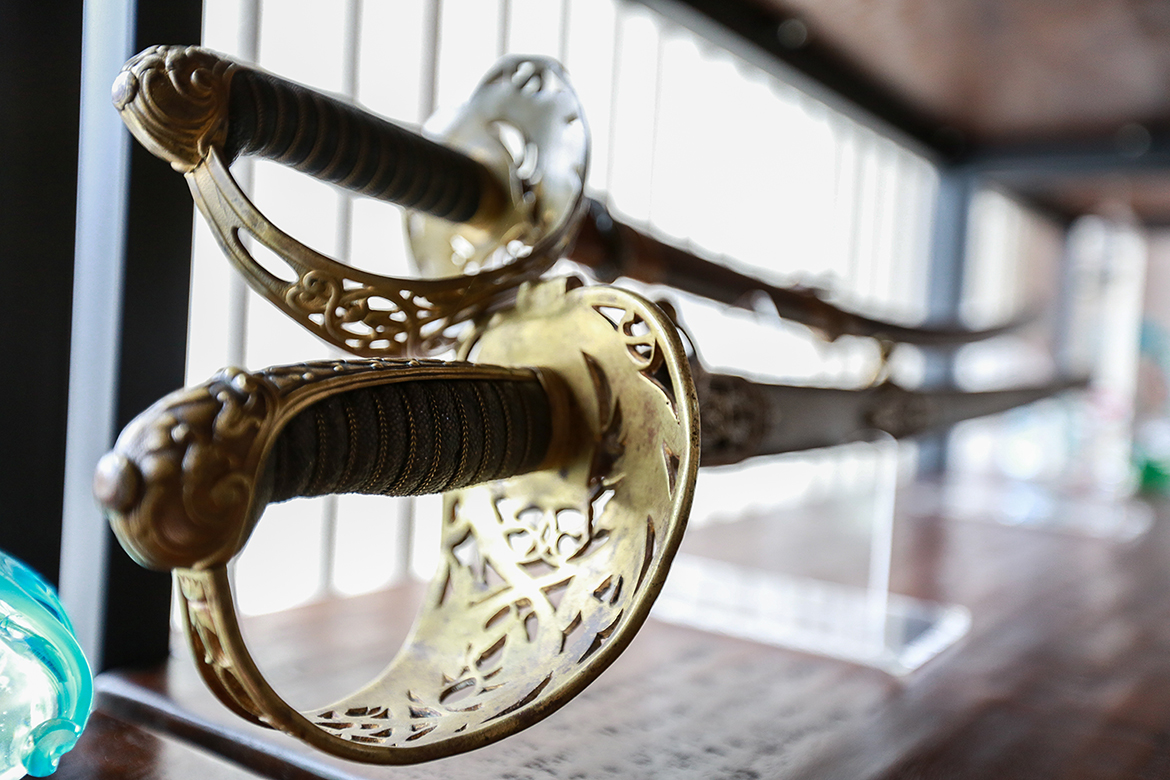
First, Dr. Ayca shared a favorite family recipe for stuffed grape leaves (dolmas). She took us through the steps of making the Mediterranean staple. Her version of the dish is based on her mother-in-law’s recipe. We were also taken on a jaunt back in time through Dr. Korhan’s stories of how he has accumulated his extensive collection of Native American artifacts — many of them native to Pike County and surrounding west central Illinois counties — which he carefully laid out on the kitchen countertops during our visit. At Dr. Ayca’s urging, we followed him into their cozy living room, where he also recounted how he has come to collect swords from various eras in history. His sword treasure trove includes a Japanese sword dated to 1316, a Revolutionary War sword from 1763 found in Calhoun County (Illinois), and two Tiffany & Co. Civil War-era swords, one from 1862 and another from 1863.
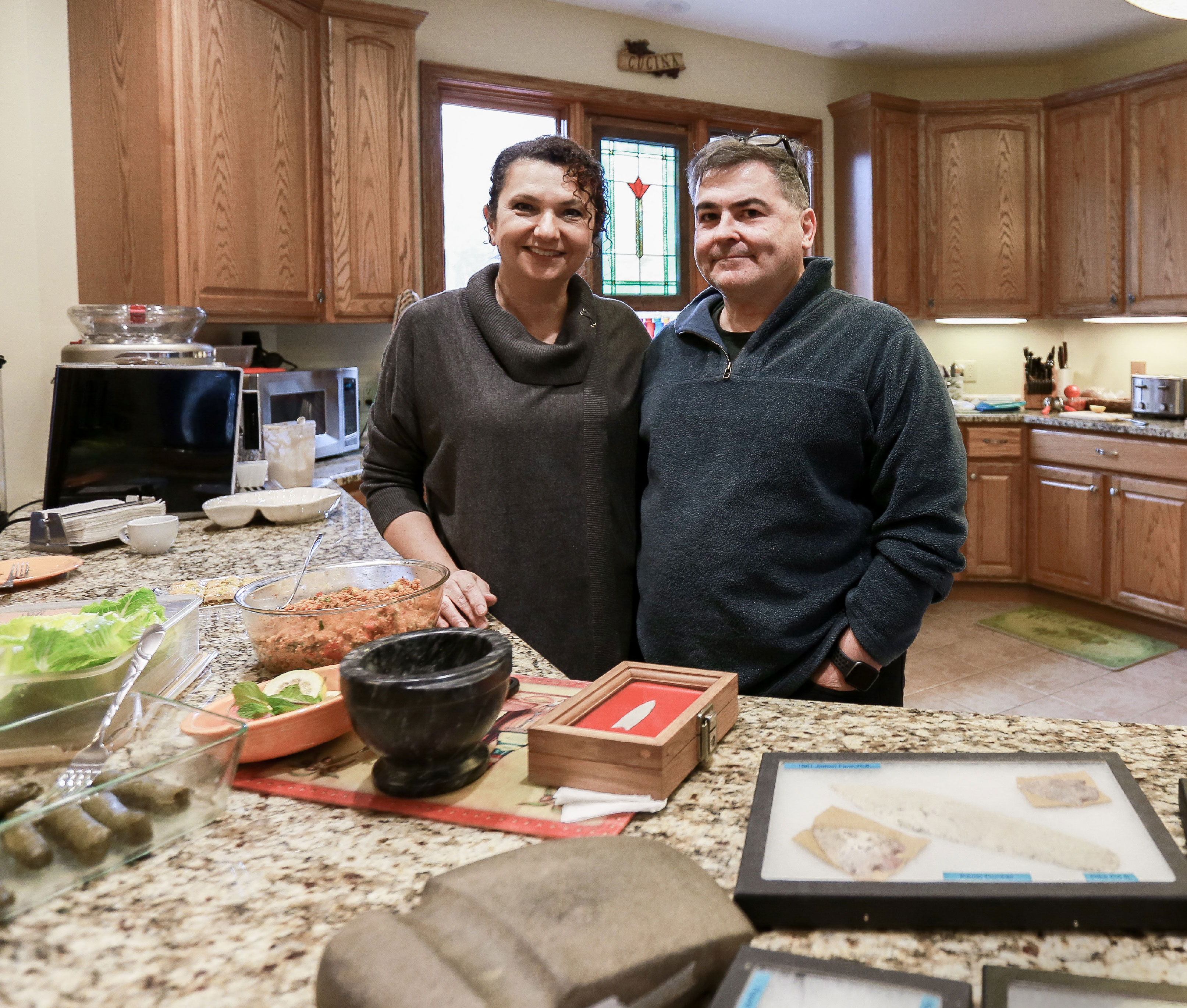
Dr. Korhan, who practices internal medicine, and Ayca, a pediatrician, met when they were both in medical school in Istanbul, Turkey. Dr. Ayca hails from Turkey, and Dr. Korhan, whose parents are from Cyprus, grew up mostly in England. The couple came to the Quincy area initially through Dr. Korhan, who was recruited to practice in Illinois in the mid-1990s through the office of then Illinois Senator Paul Simon. Dr. Ayca said that while her husband had dreams to practice medicine in the U.S., she had no intention of ever coming to work in the States.
“But I always wanted to come and learn medicine here,” Dr. Korhan explained. “Though, I actually didn’t come with the intent to stay. We were going to go back to Turkey and become faculty. Then we had kids and found ourselves working in this very supportive practice. That is the big thing for us,” he noted.
“Being your own boss, being in a physician-owned and managed practice and culture, that is important to us,” Dr. Ayca added.
In addition to the autonomy that working at QMG provides the Raifs, the west central Illinois region has gifted them with an idyllic place to raise their children. The Raifs’ son, Kaan, 25, and their daughter, Deniz, 23, have graduated from high school; both are studying medicine at the University of Illinois, Chicago. On their 140-acre Pike County property, too, they indulge in their love of nature. Their land includes both woodland and farmland, providing Dr. Korhan many opportunities to hunt for arrowheads and other Native American artifacts. Collecting them is a hobby that his patients have helped foster.
“I became interested in it by reading about it, and I see a lot of farmers as patients, so then I started asking them. Generally, they know the places to go to search, where the sites are to find this stuff. Usually in the spring and the fall, after it rains and when the fields are being plowed, I’ll go out and walk, usually two-three hours at a time. Many times, Ayca and the children, when they were home, have come with me.”
“Around here, it’s a family adventure,” Dr. Ayca added. “You don’t always find stuff,” Dr. Korhan noted. “But some days you get lucky, and you find something really good.”
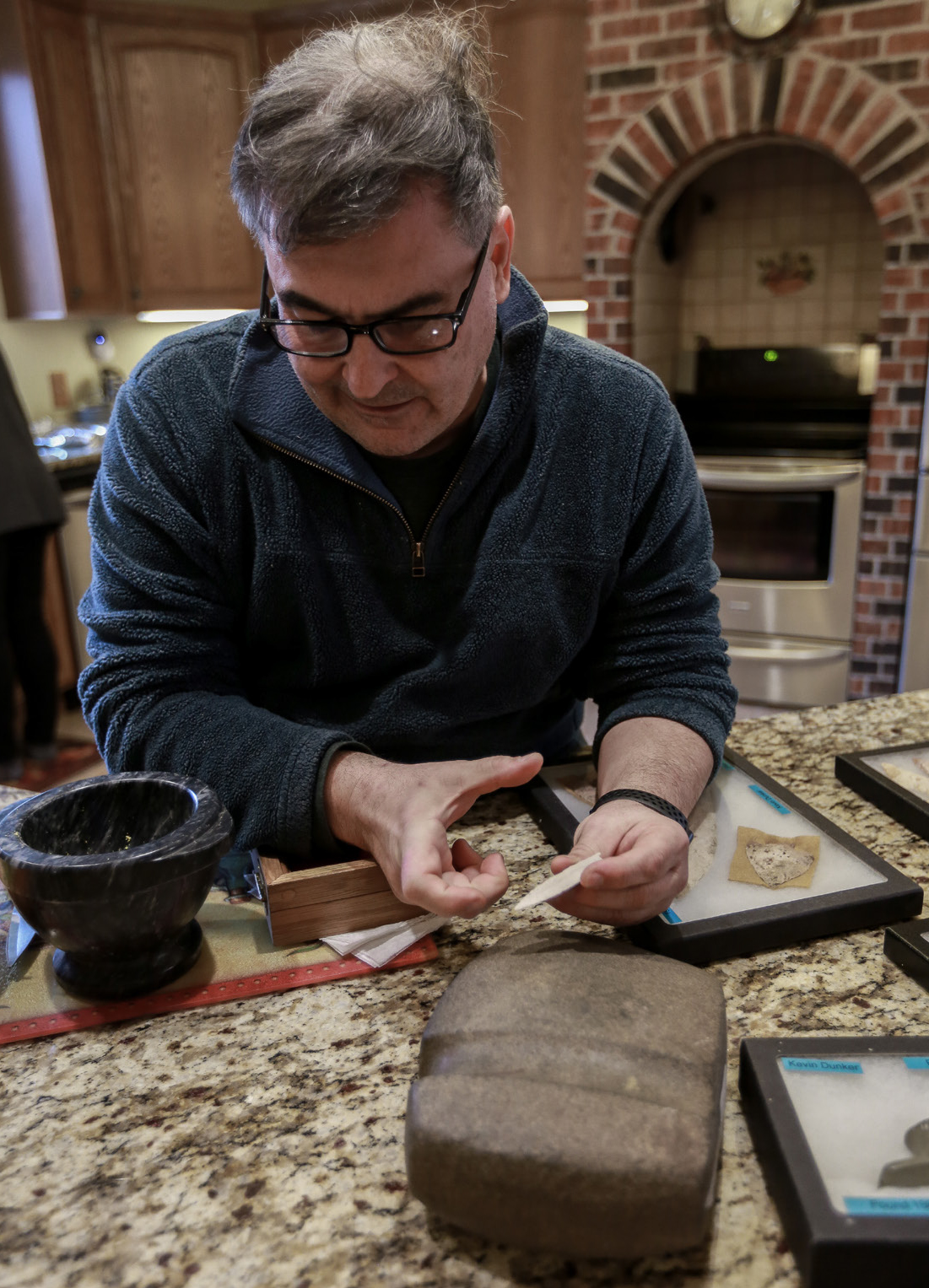
“A patient had called me and told me he had found this arrowhead, and when I saw it, I knew it was something rare because of how it was made. This is around 15,000 years old, the type of arrowhead you would use to kill a mastodon,” he said. “In general, the larger an arrowhead is, the better it is. But this is an exception. This is called a Folsom point,” Dr. Korhan said. “It has a ‘flute’ on the sides, and when making the arrowhead, to create this, they had to turn it upside down and had to hit it precisely, taking a flake off at a time. You can see how thin that is. Fewer than 50 found of these have been found in the in the state of Illinois, so, again, it’s very, very rare.” Photo by Jen Roberts
 Koltz Klips